
Jackson County Release Date Types
Texas records use several dates that answer different questions. The sentence maximum is the outside term imposed by law and judgment, subject to credit and sentence structure. Parole eligibility marks when review may become available. A Projected Release Date is TDCJ's current calculation under the offense date, offense type, mandatory-supervision rules, Board action, and maximum expiration. A Scheduled Release Date is a later operational date posted after certificate review. The Actual Release Date records the completed event.
County jail timing is different. A person awaiting trial has no sentence-based projection. A bond order can permit release, but jail staff must confirm posting, identity, other holds, and processing. A dismissal or time-served judgment may authorize exit without proving its exact hour. A sentenced county inmate may have commitment or jail credit, but no official Jackson County local good-time policy or weekend-release practice was located.
Scheduled vs actual: TDCJ warns that a scheduled date may change without notice, even on that date. Confirm the completed event afterward.
- Projected date
- A current corrections calculation that can change.
- Scheduled date
- A later operational date after release-certificate review.
- Actual date
- The date custody truly ended for that agency.
- Detainer
- A request or authority that can lead to transfer or continued custody.
Find Jackson County Projected Release
Begin by identifying the custodian. Jackson County Jail and TDCJ do not use the same record system. The county jail handles local pretrial and short-sentence custody. TDCJ administers state prison sentences elsewhere. A conviction in Jackson County does not mean the person remains in the county jail.
- Confirm the person's full identity with date of birth, case number, booking number, TDCJ number, or SID number.
- For a current state prisoner, open the TDCJ inmate search. Search by last name plus first initial, seven-digit TDCJ number, or SID number.
- Compare the conviction county, offense, sentence, and location before reading Projected Release Date or parole information.
- For Jackson County Jail, call 361-782-5407 and ask whether the booking is pretrial or sentenced. Seek the commitment and actual jail calculation from the jail and sentencing clerk.
- Check the signed court judgment for sentence, jail credit, and whether terms run together or in sequence. Do not substitute a docket listing for the order.
- After the expected event, obtain the Sheriff's release record or TDCJ incarceration history and release certificate.
The Jackson County released-inmate search gives the full path for the completed local record. Before release, the current TDCJ detail is useful. After a person leaves TDCJ, the online search drops the former inmate, so absence is not a historical result.
Note: TDCJ states that its online search covers current prisoners and can be at least one working day old.
Jackson County TDCJ Date Fields
TDCJ's definition of Projected Release Date changes with the legal category. For eligible offenses before September 1, 1996, the projection can be a mandatory-supervision date if parole has not occurred. For offenses on or after that date, mandatory supervision is discretionary. If the Board denies it, or the offense is excluded, TDCJ can recalculate the projection to discharge or maximum expiration. A later approval may move the projection forward for processing.
The TDCJ Ombudsman explains that Scheduled Release Date and Scheduled Release Location may appear after the release certificate is received, audited, and calculated. The stated processing period is about 14 to 21 business days, but the same source warns that the scheduled date can move at any time. The field is operational, not a guarantee.
The official TDCJ information page defines the projected field and provides the post-search request route.
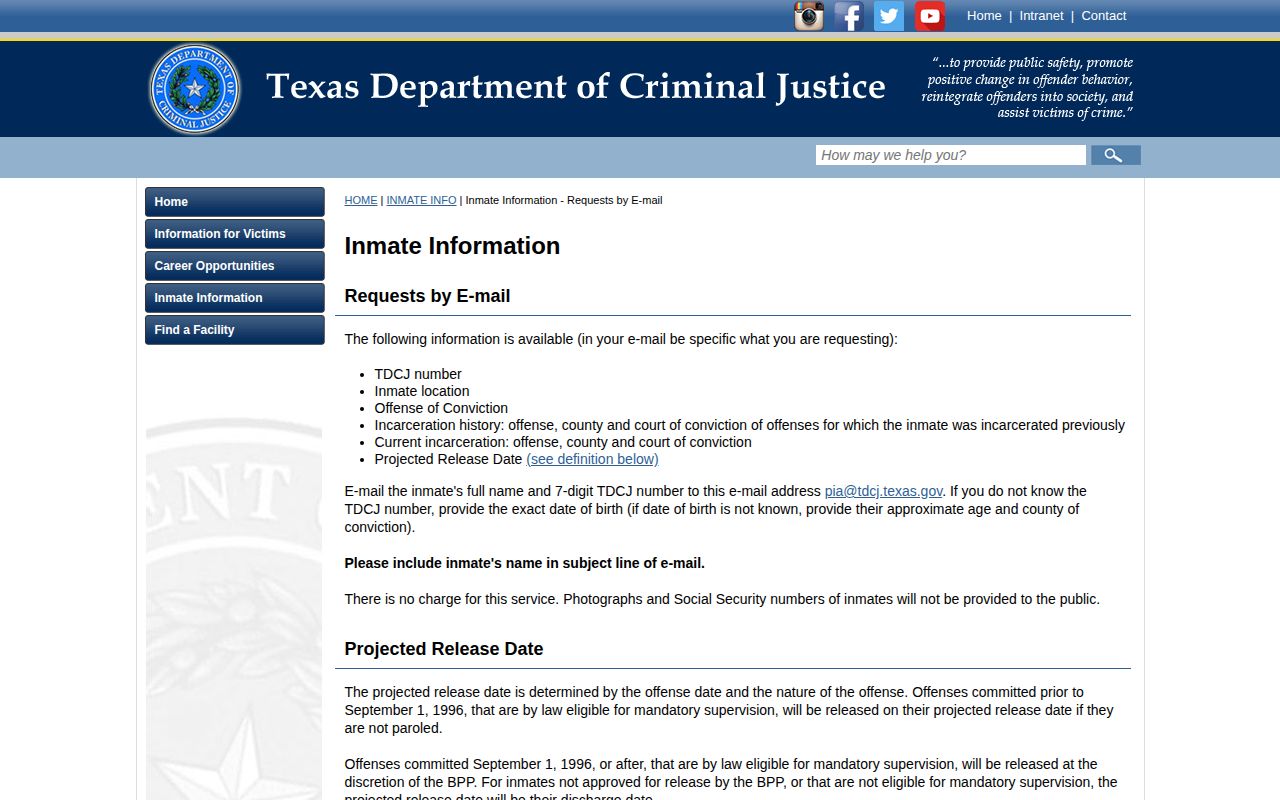
This source is also the fallback after a released person no longer appears in the current-inmate search.
| Record label | Correct reading |
|---|---|
| Parole Eligibility Date | Earliest review point under the applicable rule, not a release promise. |
| Projected Release Date | TDCJ's current statutory projection. |
| Scheduled Release Date | Later processing date after certificate audit, still subject to change. |
| Scheduled Release Location | Planned processing location, not proof of community arrival. |
| Actual Release Date | Historical completion that should replace the prediction. |
Jackson County Good-Time Rules
Texas Government Code Section 498.003 makes good conduct time a privilege, not a right. It affects eligibility for parole or mandatory supervision but does not otherwise reduce the judicial sentence term. Rates vary by classification and participation. Credits may be forfeited, and classification can change. County-jail time certified to TDCJ may also enter the state calculation under the statute.
The usual claim that good time simply “shortens the sentence” is too broad. Qualifying credits can move an eligibility or mandatory-supervision calculation. They do not guarantee Board approval or prevent an exclusion from applying. TDCJ's records office, not informal arithmetic, supplies an authoritative individual calculation.
Parole eligibility also depends on the correct subsection of Government Code Chapter 508. Section 508.145(f) generally uses calendar time plus good conduct time equal to one-fourth of the sentence or 15 years, whichever is less, subject to other rules. Section 508.145(d) uses actual calendar time for listed serious offenses, disregards good time at that threshold, and applies its own one-half-sentence or 30-year limit and minimum. Section 508.149 lists mandatory-supervision exclusions.
Note: Eligibility means a case can be considered. It does not order parole, set an exit hour, or prove release.
No Jackson County 85 Percent Rule
Texas has no blanket rule requiring every prisoner to serve about 85 percent. That shorthand belongs to other contexts and does not replace Texas offense-specific law. A sound estimate needs the offense, offense date, sentence, jail credit, exclusions, good-time class, disciplinary history, parole vote, detainers, and any later court action.
This is Jackson County's distinctive release-date angle. A single percentage cannot reconcile a county pretrial booking, a county sentence, and a TDCJ prison term. Nor can it predict whether the Board will grant discretionary mandatory supervision. Use the statute for general categories and TDCJ for the named person's calculation.
The Board review itself has stages. An Institutional Parole Officer prepares a case summary, and a three-member panel votes. An FI approval may set a future month or program condition. “Approved” therefore does not mean “released today.” Review & Release Processing handles the operational stage after approval.
Why Jackson County Dates Change
Release dates move because the facts and legal rules feeding the calculation can move. The best response is to identify the changed field and ask the custodian for an updated computation or record. Avoid trying to reverse-engineer an individual sentence from portal snippets.
| Factor | Possible effect |
|---|---|
| Credit or classification | Credits may accrue, be forfeited, or be recalculated. |
| Board action | Parole or discretionary mandatory-supervision approval or denial can change the projection. |
| Certificate audit | TDCJ review can produce or revise a scheduled date and location. |
| Court order | A corrected judgment, sentence, or credit order can alter source data. |
| Detainer or hold | One custodian may release the person directly to another. |
| Administrative processing | A scheduled date or location may change, even late in the process. |
A detainer creates a vital wording issue. The original custodian's release date may be accurate even when the person never enters the community. Ask both whether that agency's authority ended and where the person went. A transfer to TDCJ, another county, USMS, or ICE is continued custody.
Confirm Jackson County Actual Release
For a Jackson County Jail event, call the jail and request the Sheriff's booking-and-release record. Ask for the actual date and time, release authority or type, hold fields, and transfer destination if maintained. The signed court judgment explains why release could occur, while the Sheriff record establishes the local physical outcome.
For TDCJ, email pia@tdcj.texas.gov with the full name and TDCJ number. If the number is unknown, provide exact date of birth, or the identifying alternatives accepted on the TDCJ page. Ask for incarceration history and completed release or discharge information. Use the OGC public-information route for the release certificate or detailed calculation record.
A pending alert can be registered through the Jackson County VINELink inmate search. Treat the alert as time-sensitive notification, then corroborate it. If parole applies, Jackson County maps to the Victoria District Parole Office. If federal or immigration custody follows, use the receiving system rather than assuming a community release.
Final check: Replace every projection with the actual custodian record once release or transfer has occurred.
When a court record and TDCJ date seem inconsistent, request the actual time calculation and release certificate rather than choosing the earlier date. The Jackson County judgment establishes the sentence and credit ordered by the court, while TDCJ applies the governing statutes to its confinement record. Record the date on which each source was viewed because a projection can be recalculated. Once custody ends, identify whether the outcome was parole, mandatory supervision, sentence discharge, or transfer, and cite the completed agency record.